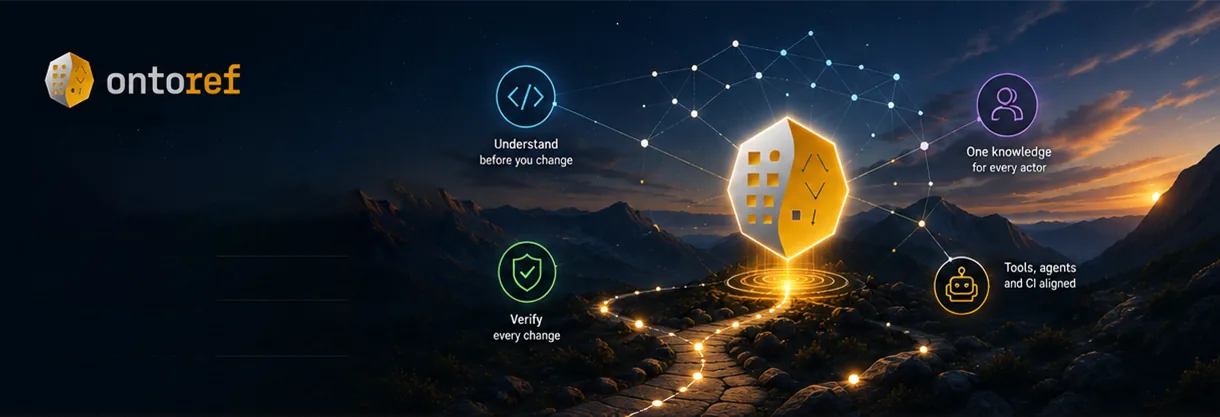
Sure-footed, and light on your feet.
Your project, your infra, your work, your life: still on the path you set?
A project, an infrastructure, a life: are you still going where you said you were going?
When your reason for being is verifiable and not just declared, holding your course stops costing effort.
What you put down, anyone can check.
What a project that knows itself can do
Three capabilities from one typed substrate — ask what breaks, verify who changed it, reach it from every actor. Independent of any runtime.
Blast radius, before the diff
Ask what a change ripples into — which nodes, which invariants, which ADRs — before you write a line. The codebase you just inherited can tell you what is load-bearing.
A trail anyone can verify
Every change to authoritative state clears typed preconditions, then deposits an Ed25519 witness in a replayable, content-addressed oplog DAG. Any party verifies the history against actor keys — without trusting whoever produced it.
Same ontology, every actor
People, agents, and CI read one typed graph — from the terminal, from the IDE, from the pipeline. Knowledge that fails the build when it drifts, not at the next audit.
Architecture
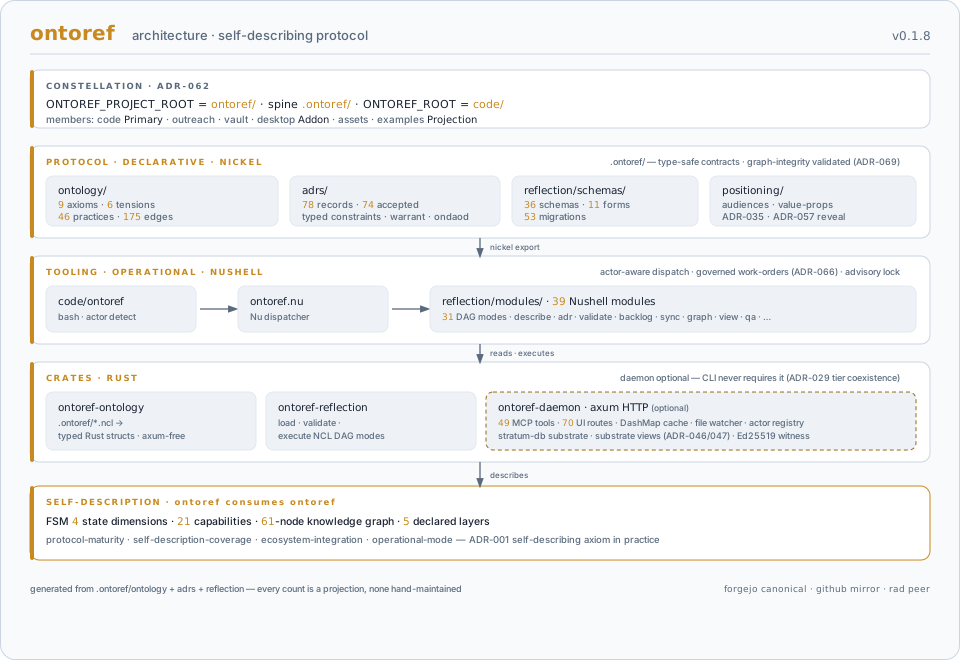
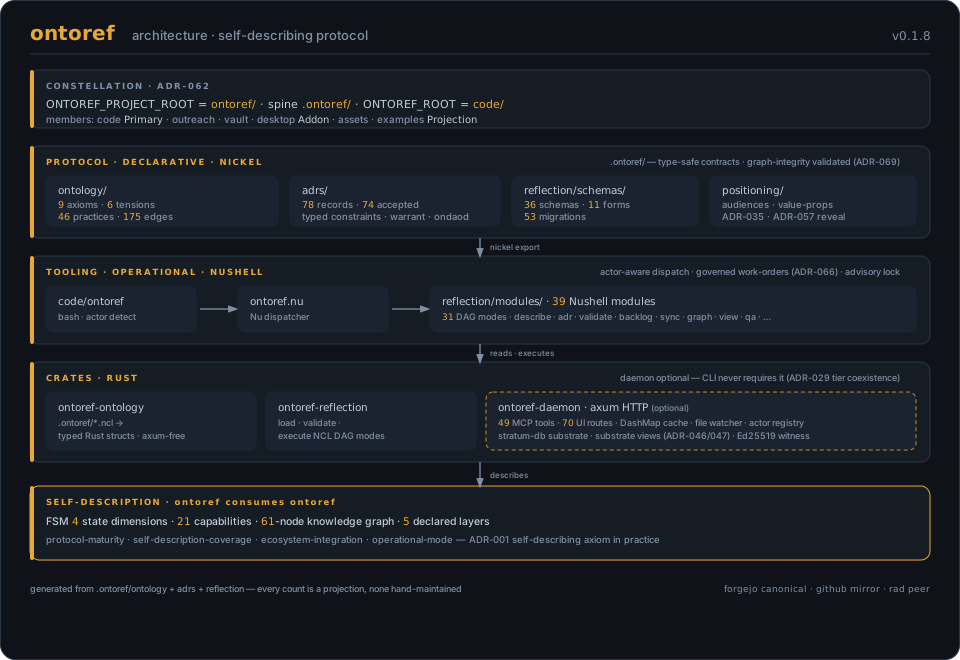
Protocol layers — entry point → declarative NCL → operational Nushell → optional Rust runtime. Each layer is independently testable.
Adopt in Any Project
Three commands. No lock-in.
ontoref setup
Scaffolds .ontology/ and reflection/ with typed NCL files. Idempotent — safe to re-run after upgrades.
ontoref describe project
Query your project's identity, axioms, tensions, and FSM state from the terminal. Actor-agnostic — same output for developer, agent, or CI.
ontoref run start
Start the daemon for HTTP UI and MCP. Configure via ~/.config/ontoref/config.ncl. The protocol works without it.
Structure Your Project's Knowledge
Install the CLI, run ontoref setup, and your project gains machine-queryable invariants, living ADRs, actor-aware operational modes, and optional daemon context sharing.