The ontoref ladder
Seven rungs between «I declare it» and «it can be checked»
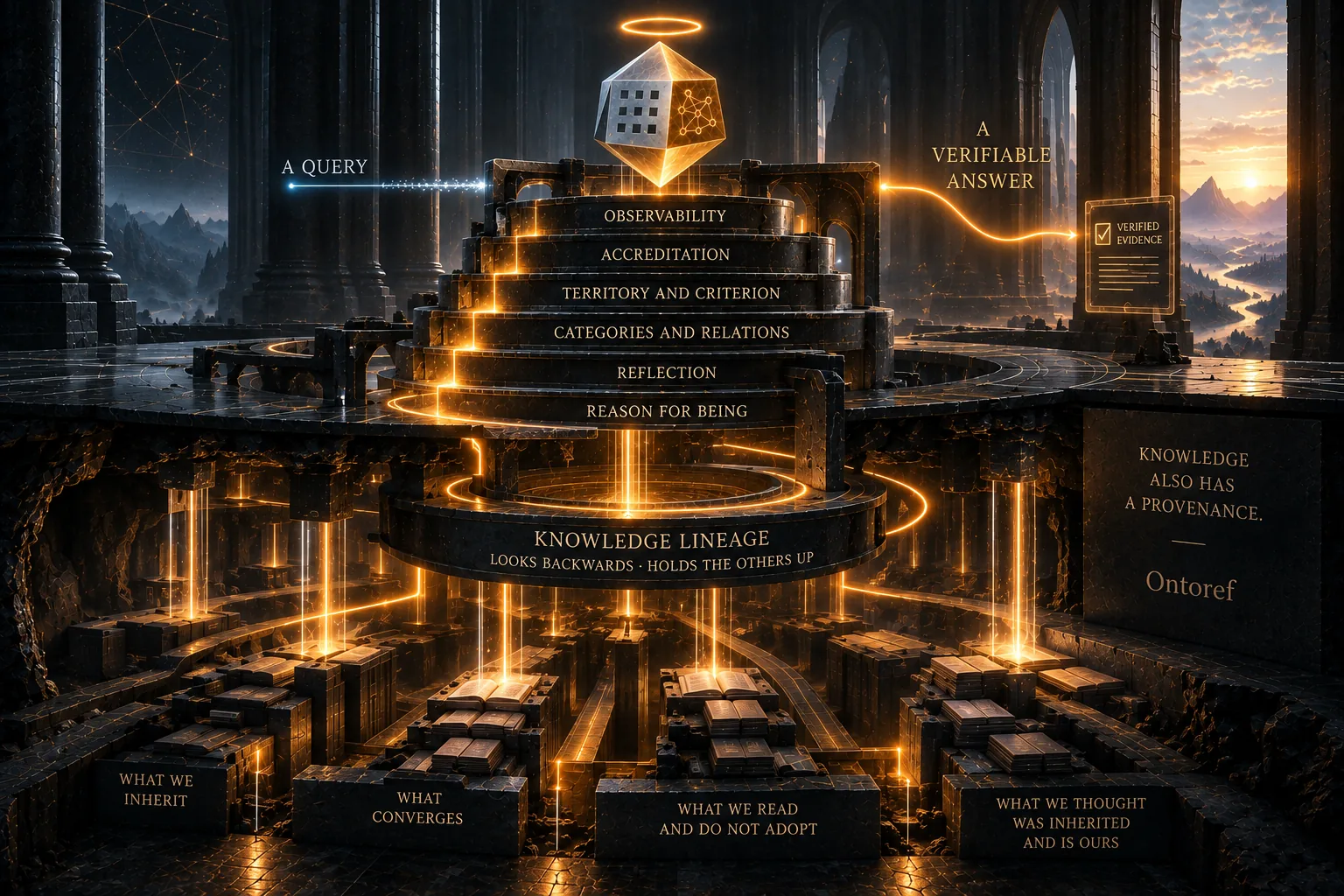
A living project has a reason for being, and almost every project has one written down somewhere. What almost none of them has is the ability to ask it again. That difference is not one of degree. A project whose reason for being is only remembered is not alive: it is being remembered.
Between «I declared it» and «it can be checked» there is a ladder of six rungs, and a seventh that almost nobody climbs because it faces backwards. Each one is the condition of the next. None of them is a virtue: all seven are mechanisms, and each is demonstrated by a verb somebody can run in front of you.
This page is not written here: it is projected from .ontoref/reflection/ladder.ncl, the same file «ontoref ladder» answers from in the terminal, and from the essay «The ladder that holds».
The same walk with each command's real output, as slides →
| Rung | What it claims | |
|---|---|---|
| 1 | Reason for being | The reason for being lives somewhere that can be asked again, and answers with what the project is today without anyone rewriting it for the occasion. |
| 2 | Reflection | What the project knows about itself gets executed — a mode, a step, a verifier — and leaves a trace of having run. |
| 3 | Categories and relations | What is stated is in a closed vocabulary with declared relations, which is the precondition for a validator to exist at all. |
| 4 | Territory and criterion | How far the governed reaches is declared, and so is what measures that it still does; the criterion refuses on a failing condition, and what must not be decided is held by reporting direction instead of imposing a winner. |
| 5 | Accreditation | The terms are declared before and outside whoever executes, whoever executes emits signed evidence, and what is verified is that evidence and not their report — named responsibility, not a principle of authority. |
| 6 | Observability | There is a question that returns the distance between what is declared and what is there, because observing is cheaper than remembering and remembering fails silently. |
| 7 | Knowledge lineage | Where what the project knows came from is on record with an address, a quote and custody — including what was read and touched nothing, and what was believed inherited and was its own. |
1 Reason for being
A reason for being you can ask again
The reason for being lives somewhere that can be asked again, and answers with what the project is today without anyone rewriting it for the occasion.
It is the first: it presupposes no other.
Why it matters
Declaring why a project exists is cheap and happens once. Keeping that declaration answerable — responding today, with what the project is today — is an entirely different thing, because it requires the declaration to live somewhere that can be asked, rather than in the memory of whoever wrote it or in a document nobody opens again.
The proof that a reason for being is alive is not that it sounds convincing. It is that the question can be put to it again and it answers without anyone rewriting it for the occasion.
What no check answers
Whether what the file answers is still the project's actual reason for being, or a sentence that stopped being true and nobody re-read. No check can compare a declaration against an intention; it can only confirm the declaration is reachable.
What checks it
Verbs that answer it
ontoref describe projectontoref about
Necessary conditions: a machine checks them, and meeting them does not hold the rung
.ontoref/ontology/core.nclexists.ontoref/ontology/state.nclexists
Anchored in the nodes
2 Reflection
What the project knows about itself gets executed
What the project knows about itself gets executed — a mode, a step, a verifier — and leaves a trace of having run.
Stands on: Reason for being
Go deeper: Governed delivery: commission, statement of work, work order and witness →
Why it matters
A project can know a great deal about itself and be able to do nothing with that knowledge. That is the default state of nearly all architecture documentation in existence: true, complete, and without any consequence for what happens on Tuesday morning.
Reflection is what turns that knowledge into an act. It is not writing about what you do: it is that what you know can be executed — a mode, a step, a verifier — and leaves a trace of having run. Without that rung, the first one produces admirable prose and nothing tangible.
What no check answers
Whether the declared modes are actually RUN. A mode nobody invokes is inert rather than still, and the distinction is invisible to a check over declarations: measured 2026-08-14, governed-delivery ran twice in six weeks while generate-article ran twenty-six times, and both were equally present on disk.
What checks it
Verbs that answer it
ontoref describe capabilitiesontoref run <mode-id>ontoref mode list
Necessary conditions: a machine checks them, and meeting them does not hold the rung
.ontoref/reflection/schema.nclexists.ontoref/reflection/modes/update_ontoref.nclexists
Anchored in the nodes
3 Categories and relations
Naming with categories is what makes a statement checkable
What is stated is in a closed vocabulary with declared relations, which is the precondition for a validator to exist at all.
Stands on: Reflection
Why it matters
This is where most honest attempts stop, and not for want of rigour but for want of types. A claim in prose can be believed or disbelieved; it cannot be validated. For something to be checkable it has to be stated in a closed vocabulary with declared relations: this is an axiom, that is a tension, this node depends on that one, this decision rejected these alternatives.
That argument is about three thousand years old and is better put than we would know how to put it. The Great Appendix of the Yi King opens by conceding the defeat of language — the written character does not exhaust speech, speech does not exhaust the idea — and asks whether the meaning is therefore lost. The answer is not better prose. It is to institute a notation: «The sages made their emblematic symbols to set forth fully their ideas; appointed (all) the diagrams to show fully the truth and falsehood (of things); appended their explanations to give the full expression of their words» (App. III, Sect. I, ch. XII, p. 377, Legge's translation).
Three things in one sentence. That prose was measured insufficient. That the remedy is a notation making decidable what the words left open — which is a validator's founding charter. And the ordering: the explanations are appended to the figures, never standing in their place. That ordering is exactly the rule this project has broken more than once, every time a carrier held a copy of a governed fact instead of invoking it.
Naming with categories is not bureaucracy: it is the precondition for a validator to exist at all. Without categories there is nothing to validate, only something to believe.
What no check answers
Whether the categories CARVE the domain or merely cover it. A graph can typecheck perfectly while its vocabulary names the wrong joints, and the corpus holds a measured instance of the shape: the pole enum borrowed a two-dimensional vocabulary (a value AND its place) and kept one dimension, with the second living unjoined under level.
What checks it
Verbs that answer it
ontoref validate ontologyontoref describe term --listnickel export
Necessary conditions: a machine checks them, and meeting them does not hold the rung
code/ontology/schemas/core.nclexistsmake_nodeappears in.ontoref/ontology/core.ncl
Anchored in the nodes
4 Territory and criterion
The territory, the criterion — and what is held without deciding
How far the governed reaches is declared, and so is what measures that it still does; the criterion refuses on a failing condition, and what must not be decided is held by reporting direction instead of imposing a winner.
Stands on: Categories and relations
Why it matters
A criterion without a territory governs nothing, because there is no saying what it applies to. A territory without a criterion governs nothing either, because there is no saying when it has been left. Governability rests on both at once: how far what you govern extends, and what measures that it still does.
And there is an asymmetry worth stating in full: the criterion must refuse on a concrete failing condition, never on a preference. A gate that refuses because somebody dislikes something is not government, it is opinion with permissions.
But the part almost nobody states is the third. Not everything a project holds can — or should — be resolved. Some pairs of opposites are constitutive: formalising and being adopted, enforcing and letting emerge, opening up and staying viable. A gate that forced a choice between the two sides would not be governing, it would be amputating. Which is why the criterion has two forms: the one that refuses, on a failing condition, and the one that reports direction and does not refuse at all. The second exists so that the opposites can go on coexisting while the project moves between them, without either winning by attrition and without anyone having to declare a victor in order to commit.
The gate is not there to close the tension. It is there so the tension can be held without collapsing, and without its cost dropping out of sight.
What no check answers
Whether a criterion that exists can actually LOOK at its subject. The corpus catalogues gates inert since a layout change, a scan that aborted and never ran once, and a must_be_empty reporting SATISFIED over a path that did not resolve — every one of them declared, and every one of them green.
What checks it
Verbs that answer it
ontoref constraintontoref sync auditontoref describe constraints
Necessary conditions: a machine checks them, and meeting them does not hold the rung
.ontoref/ontology/gate.nclexistsmake_membraneappears in.ontoref/ontology/gate.ncl
Anchored in the nodes
internal-coherence-enforced, governed-delivery, plane-habitability
5 Accreditation
Who answers for it — the accredited seam
The terms are declared before and outside whoever executes, whoever executes emits signed evidence, and what is verified is that evidence and not their report — named responsibility, not a principle of authority.
Stands on: Territory and criterion
Go deeper: Governed delivery: commission, statement of work, work order and witness →
Why it matters
A criterion says what must hold. It does not say who committed to its holding, nor who answers when it does not. That is a separate rung, and it is the one that turns sustainability into responsibility rather than into good intentions.
It has three pieces and the order matters, and all three have carried names here since before this ladder. First the Statement of Work — the terms layer, with its scope, its falsifiable contract and its validation mode, owned by the human and outside the agent's editable surface. That ownership boundary is what resolves the fox-and-henhouse problem, and it is not a metaphor being added: it is the declared reason the SOW sits where it sits. Second the Work Order: the execution layer running under one SOW, disposable and contained, carrying the deliverable, its observability envelope, the verified witness and a contained verdict — so that a failure dies inside the Work Order rather than contaminating the session. One SOW authorises many Work Orders.
And third, the verified witness: a content-addressed, Ed25519-signed receipt deposited at the seam between the axes. Here it is worth saying exactly what it proves and no more: it proves that a check ran and what it returned — structure, never truthfulness. It is not a barrier. It is post-hoc evidence that X happened, not something forbidding not-X, and it becomes a gate only where a control point refuses to proceed without a valid one. What does change everything is which thing is believed: the evidence is verified, not the performer's own report.
It is stated outside this project with more precision than we would manage. The plan of the work is «a recipe that identifies which steps will be performed, by whom, and in what order.» (in-toto, § 3.2.1, p. 1396), and the relation between what was planned and what is proven is exact: «There is a one-to-one relationship between the step definitions in the supply chain layout and the link metadata.» (§ 3.2.2, p. 1396). Those who execute may be people or systems, treated identically: «Functionaries can be humans carrying out a step (e.g., signing off a security audit) or an automated system (e.g., a build farm).» (§ 3.1, p. 1395). In an era where a good part of the work is carried out by an agent, that symmetry stops being an elegance and becomes the precondition for holding anyone to account.
This is not a principle of authority: it is its exact opposite. Authority says «believe me because of who I am»; accreditation says «I signed this, check it yourself». A witness does not ask for trust, it makes trust unnecessary — and at the same time it leaves the responsibility resting on somebody with a name, directly and unambiguously. It is also what keeps the previous rung from degrading: a criterion nobody signs binds nobody.
The shape of the document that carries all this is old and well studied. Such a commission is a single text, readable by people and parsable by programs, signed and bound to a secure identifier, and that text exhausts the discussion: «Our intent is that the contract is the beginning and the end of the discussion; we call this principle the rule of one contract.» (Grigg, § 3.3). This project departs from him on one point, and holds it on record as a trade rather than a defect: it identifies the commission by a stable name instead of by the document's hash, because a decision that gets amended has to remain the same decision. It gains stable identity under change, and pays with a link that can lie.
What no check answers
Whether the accredited path is REACHABLE, which for this project it is only in half. The commitment half runs (extraction stamps _refs.ncl and a pre-commit gate asks for it), while the per-actor witness is tier-2 behind POST /ops and no service runs it — so the checks above pass over a schema and a public key while the act they exist for is dormant. That gap is a decision waiting, not effort waiting, and no FileExists will ever say so.
What checks it
Verbs that answer it
ontoref sync substrateontoref positioning witness-ondaod <signal-id>
Necessary conditions: a machine checks them, and meeting them does not hold the rung
code/ontology/schemas/sow.nclexists.governance/witness.pubexists
Anchored in the nodes
6 Observability
You cannot improve what you do not observe, and observing is cheaper than remembering
There is a question that returns the distance between what is declared and what is there, because observing is cheaper than remembering and remembering fails silently.
Stands on: Accreditation
Why it matters
Everything above drifts. Not because nobody cares, but because the world moves and declarations do not. The only defence that works is for the drift to be observable: for there to be a question that returns the distance between what is declared and what is there.
This project paid that lesson in its own house. An agent context file spent six weeks announcing a drift that the very decision describing it had already closed by amendment. Nothing failed. Nothing warned. The note outlived the problem by six weeks, and was only found because somebody asked the governed surface instead of reading the reminder.
Observing is cheap. Remembering is expensive, and it fails silently on top.
What no check answers
Whether a green states its own REACH. A check that reports success without saying what it covered is the failure this project publishes its own answer to, and it was committed by the validator of the surface that publishes it — positioning validate counted 96 passes over eight subdirectories while the whole sources/ tree, spine.ncl and the taglines were never opened, and nothing said so.
What checks it
Verbs that answer it
ontoref describe diffontoref sync auditontoref health --fullontoref adr amendments
Necessary conditions: a machine checks them, and meeting them does not hold the rung
.ontoref/ontology/_refs.nclexistsstate_rootappears in.ontoref/ontology/_refs.ncl
Anchored in the nodes
7 Knowledge lineage
Lineage, which faces backwards and holds the other six up
Where what the project knows came from is on record with an address, a quote and custody — including what was read and touched nothing, and what was believed inherited and was its own.
Stands on: Observability
Why it matters
The six rungs above are a project knowing itself now. The seventh is the same mechanism turned towards the past: where what you know came from.
Without lineage, an achievement looks like a gift. And someone who believes they were given a gift stops growing, for the simplest of reasons: they do not know what they did to get there, so they cannot repeat it, teach it, or correct it. The road travelled is not the anecdote of the achievement — it is its measure.
This is the rung this project skipped for a long time, and it knows so with a date. In September 2026 the lineage of its own vocabulary was measured and the result was uncomfortable: twenty external readings on record, every one of them from that same year, and not one citation to the works the project's daily words come from. It was not a failure to read. It was the mechanism: custody demanded a URL and a held file, and a book has no URL — so a century, or thirty centuries, of thought could only enter as an unanchored assertion.
What was done about it is the rung. Custody was separated from judgement: what arrived, byte for byte, is held and never republished; what we concluded is public, typed and queryable. A book enters by its ISBN — an address that does not expire — and only the passages quoted are transcribed by hand, with their page. And the verdict belongs to the claim, not to the source: one text can supply vocabulary adopted whole and, at the same time, reveal a capability that is not built.
What was in fact inherited, and now has an address
The heart of this project — holding a dynamic of opposites without collapsing it — is not its own. It comes from two books, and since September 2026 it can be said with a page number.
From the Tâo Teh King comes the structure of the pair. Chapter 2 does not classify opposites: it says they give birth to one another. «So it is that existence and non-existence give birth the one to (the idea of) the other; that difficulty and ease produce the one (the idea of) the other; that length and shortness fashion out the one the figure of the other» (ch. 2 § 2). That is what a pole field actually encodes: not two substances but a relation in which neither member is definable without the other. A node tagged 'Yin is stating what it stands against.
And from the same book comes, almost word for word, the aspiration this project has been quoting in Spanish for years without saying whose it was: «The Tao in its regular course does nothing (for the sake of doing it), and so there is nothing which it does not do.» (ch. 37 § 1). «I do nothing and everything gets done» sat inside a tension description in the project's own graph, unattributed, until the record gave it an address.
From the Yi King comes the movement. Polarity there is not a taxonomy: it is what generates the course. «The successive movement of the inactive and active operations constitutes what is called the course (of things).» (App. III, Sect. I, ch. V, ¶ 24). That gives the discipline of not picking a pole a far stronger warrant than the psychological one: picking stops the alternation, and the alternation is the course. From the same book come the terms: yin and yang appear predicated of the lines, of the notation itself — «calling (the lines) yin and yang» (App. V, ch. II, ¶ 4) — exactly as this project predicates them of nodes and not of cosmic principles.
From the Yi King also comes the reason the movement is not linear. A line of the same value means different things according to the place it occupies: «The third and fifth lines are of the same quality, (as being in odd places), but their positions are different; and the (occupant of) the third meets with many misfortunes, while the occupant of the fifth achieves much merit» (App. III, Sect. II, ch. IX, ¶ 62). Polarity is not a property: it is a property in a place. And when a course runs out, it has not failed: «When a series of changes has run all its course, another change ensues. When it obtains free course, it will continue long.» (App. III, Sect. II, ch. II, ¶ 15). Exhaustion is the condition of the transition, not its breakdown — which is precisely what is missing from the vocabulary this project uses for a dimension that is stuck.
What was believed inherited and is not
This is where the record stops flattering, and it is the most valuable part of the whole rung.
The spiral is in neither book. It was measured, mechanically, over the held files: «spiral» occurs zero times in the Tâo Teh King and exactly once in the whole Yi King, describing a shellfish in a list of emblems; «synthesis», zero times in both. The third value of the pair — the one used for a node that is the tension rather than a side of it, the one the whole discipline exists to protect — is this project's own extension. Hegel is noted as a candidate to read, which is a different thing from a source.
Two of the three values have an anchor and the third has none. Knowing that is worth more than a clean lineage.
There is a second thing adopted by halves, and the text itself names the missing half. The Tâo Teh King's method is subtraction: «He who devotes himself to learning (seeks) from day to day to increase (his knowledge); he who devotes himself to the Tao (seeks) from day to day to diminish (his doing). […] He diminishes it and again diminishes it, till he arrives at doing nothing (on purpose)» (ch. 48 §§ 1–2). A protocol that adds a schema, a validator and a migration every session is on the increase path by construction. The aspiration was adopted without the method. That is a choice, not an oversight, and saying so is exactly what a lineage record is for.
What may not be taken
A lineage that cites only the favourable chapters is choosing the source to obtain the answer. So the record names the boundaries too.
The Yi King is a system of typed transition between sixty-four states, and its answer to «which change am I in» is forty-nine yarrow stalks. This protocol's answer is the opposite and there is no middle ground: a transition happens because a declared condition was checked and a validator refused or did not, and wherever a control point demands it, nothing proceeds without a valid witness. A gate that consulted an oracle would be indistinguishable from no gate. The structure of change is borrowable from that book; the epistemology of how one knows which change is happening is not.
And the Tâo Teh King has political chapters counselling a ruler to keep the people without knowledge and without desire. This project takes nothing from there, nor could it: it is the exact inverse of a mechanism whose entire form is publication.
The measure
The state today can be asked rather than believed: 32 sources judged, 181 claims, 171 of them carrying a literal quote and a locator, over 29 custody records that resolve. And the distribution is what makes this rung a measurable lesson in humility:
Convergent 82 · Adjacent 36 · Canon 24 · Evidence 16 · Challenge 15 · Rival 6 · Carrier 2Eighty-two claims say «this had already been reached here, and somebody else arrived by another route». Twenty-four say «this was adopted whole, it is not ours». Fifteen say «I have read this and I have not built it». And thirty-six say the reading touched nothing — the verdict that produces no content, the most repeated judgement in anyone's history precisely because it was never recorded, and therefore paid twice.
There is a third number almost nobody shows about themselves. External claims point at nodes of one's own graph, and inverting that edge reveals where this project has been reached from outside: 43 nodes reached by 32 independent readings. Readings made for different purposes, in different centuries, landing on the same axis.
That is not an argument from authority. It is the opposite: it is the list of everything this project did not invent.
What no check answers
Whether the readings were judged against what the artefact SAYS or against what the reader came to find. The corpus records one reading of its own that was nearly closed carrying six claims, all found by grepping for anchors named in advance; a second pass found three of the strongest claims in the record. Nothing mechanical distinguishes a thorough reading from a confirming one.
What checks it
Verbs that answer it
ontoref positioning sourcesontoref positioning signals <node>ontoref validate sources
Necessary conditions: a machine checks them, and meeting them does not hold the rung
.ontoref/adrs/adr-080-external-signal-custody-judgement-and-the-exportable-seam.nclexistscode/ontology/defaults/custody.nclexists
Anchored in the nodes
Why the seventh holds the other six up
You can have a reason for being, reflection, categories, criterion, accreditation and observability, and still mistake the result for personal merit. Lineage is the rung that prevents that confusion, and it does so in the only way that holds: by counting.
The Yi King says of itself the best description in existence of what a governed corpus aspires to be: «there is no thought and no action. It is still and without movement ; but, when acted on, it penetrates forthwith to all phenomena and events under the sky.» (App. III, Sect. I, ¶ 62). That is «I do nothing and everything gets done» with the right subject: not a virtuous person but a mechanism. .ontoref/ does nothing until something asks it; between one question and the next it is still and without movement.
And here the corpus refuses to round the sentence off, which is the reason for everything above. Being acted on is not free. A mechanism nobody invokes is not still: it is inert, and the difference is measured — over six weeks, the governed-delivery mode ran twice while the article-writing mode ran twenty-six times. «When acted on, it penetrates forthwith» presumes somebody who comes to consult. Half the engineering of this protocol is about the case where nobody does.
So the ladder closes where it began. A reason for being that evolves holds itself up when every rung holding it can be checked: what it does, how it is named, how far it reaches and what it holds without deciding, who answers for it, how it is observed, and where it came from.
What you leave stated, someone will be able to verify. Including who you learned it from — and also what you believed you inherited and was your own.