Adopt the protocol — or learn it
The protocol is never sold — it is opt-in, per tier, and never a runtime dependency. What is offered is help operating its highest tier and training to climb the others.
What you put down, anyone can check.
Operations & governance, run as a service
Tier 2 is where every mutation goes through a typed operation and deposits an Ed25519 witness — the journey of changes, not just the state, is held and verifiable. The protocol stays open; the witnessed surface is what is run or supported for you.
Operations-layer adoption
Stand up tier 2: domain operations as the agent's only mutation path, typed preconditions, dispatch, and the daemon. The runtime becomes the one place authoritative state can change (ADR-024).
Witnessed audit trail
An Ed25519 oplog DAG, content-addressed and replayable — a tamper-evident record any party can verify against actor keys without trusting whoever produced it (ADR-023/047, vp-004).
Custom validators & criteria
Encode your hard constraints as first-class, witnessed validators that reject ill-typed state at the three validation planes — your governance rules become checkable, not advisory (ADR-026/050).
Substrate migration
Move from scattered docs, ad-hoc scripts and a filesystem of NCL to the verifiable substrate — op log, content-addressed blobs, bitemporal triples, Merkle commitments — without a big-bang rewrite (ADR-023/029).
What you get
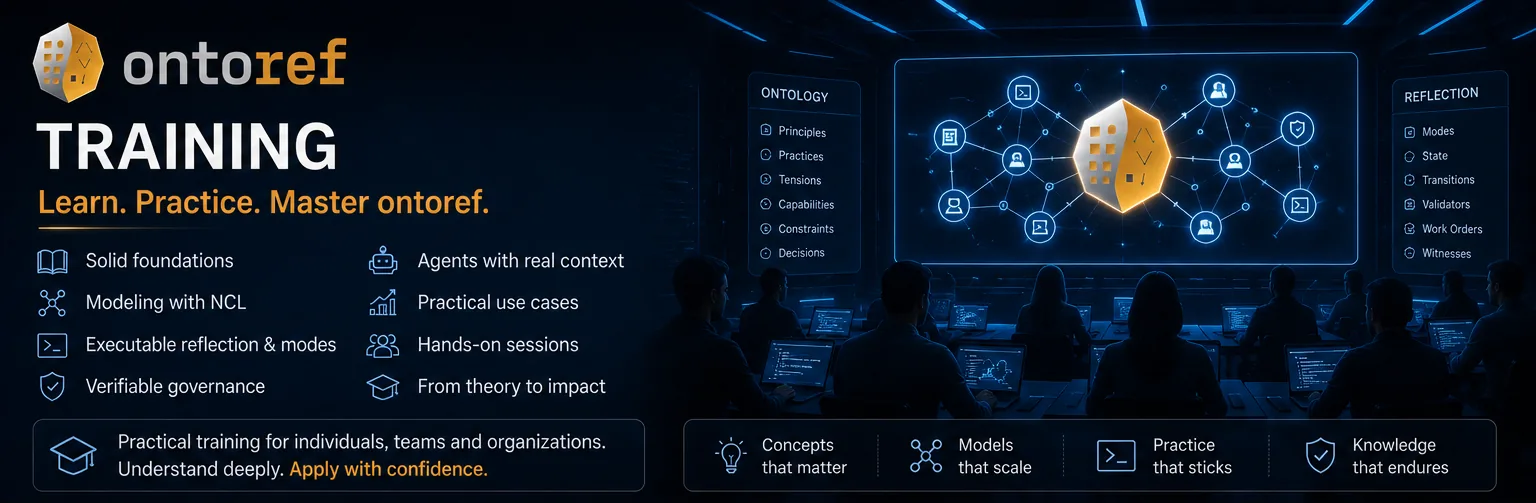
Training & coaching
Most teams should not start at tier 2. Begin by declaring what you are (tier 0) and proving your state (tier 1) — these are learnable, and the coaching meets you where you are.
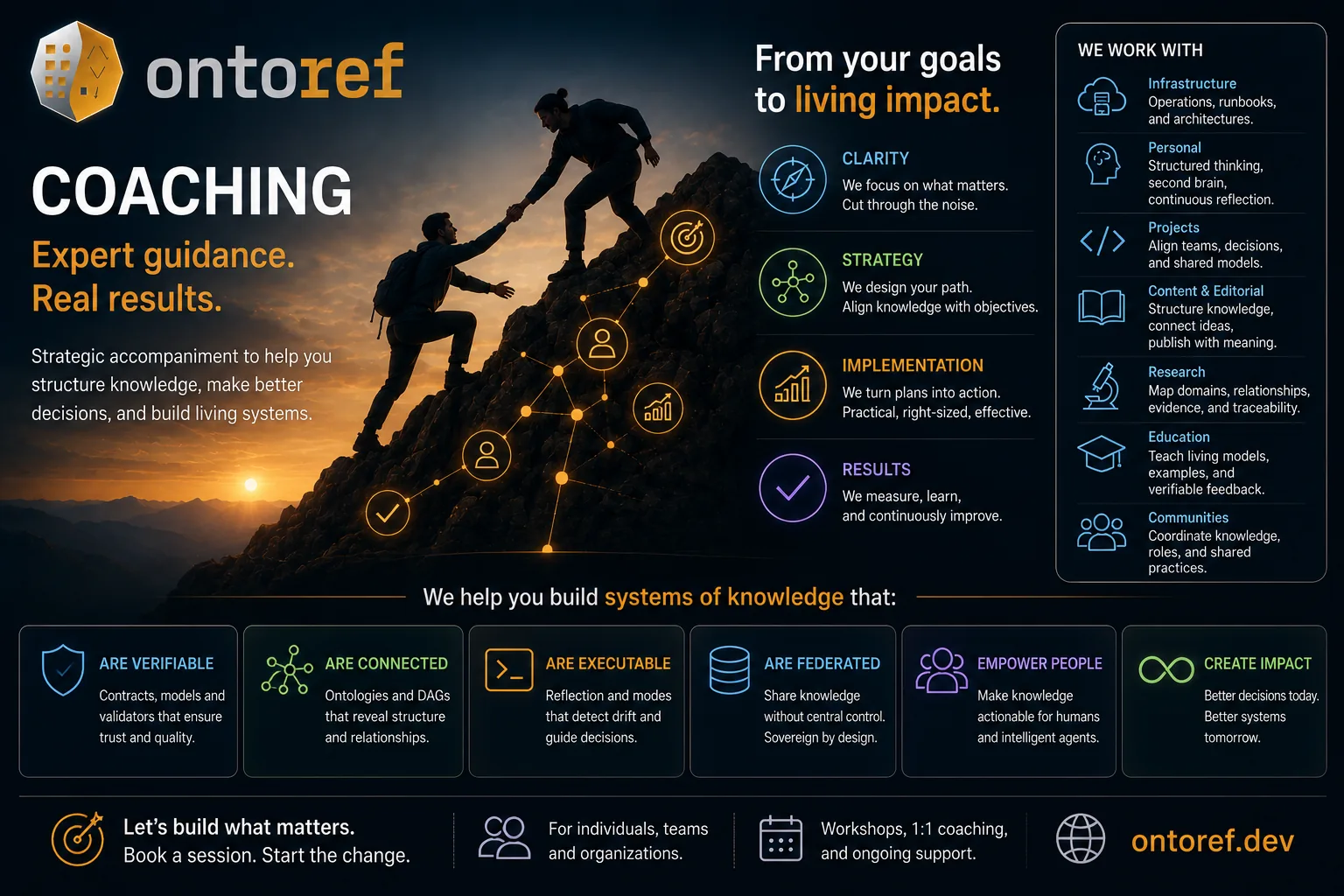
Coaching — declare your why
Hands-on guidance to put your architecture into typed NCL: axioms, tensions, ADRs and state — so an agent or a new hire understands the project from the graph, not from tribal memory.
1:1 sessions
1–2 hWork through your real ontology — name the axioms and the tensions that actually govern your decisions.
ondaod tension discipline
1–2 hLearn to hold a Spiral open instead of collapsing it — read tensions first, describe the synthesis, decide without foreclosing.
ADR & decision modeling
1–2 hTurn decisions into typed ADRs with constraints and rejected alternatives — reversible-vs-not, queryable, linked to the graph.
Ongoing guidance
ongoingRecurring sessions as your ontology grows — keep the declared why coherent with the code as it changes.
Training — prove your state
Courses and workshops on the substrate tier: commit your state so it is externally checkable before any operation exists — verification without the full operations machinery.
Custom courses
A curriculum shaped to your stack: the three-file ontology split, substrate commitments, and how describe answers self-knowledge queries.
Hands-on workshops
Your team takes a real subsystem from undocumented to declared-and-verified in a session — substrate commitment, witness-not-clone verification (ADR-028).
Talks & seminars
Conference-style sessions on operational ontology, the ontology/reflection duality, and sufficient verification over complete knowledge.
Educational content
Written guides and the projected docsite (mdBook from the ontology, ADR-060) tailored as a learning path for your team.
Which tier fits you
Adoption is graduated (ADR-029): enter with one NCL file and climb only when it hurts. You are never a hostage to a runtime or a SaaS.
Holds its why
A typed ontology plus describe: you declare the reason your project exists as NCL. Coaching gets you here.
Holds and proves itself
A substrate commitment makes your state externally checkable before any mutation. Training gets you here.
Holds its course
Ed25519 witnesses and replay determinism: every change is witnessed, so the journey is verifiable. We run or support this with you.
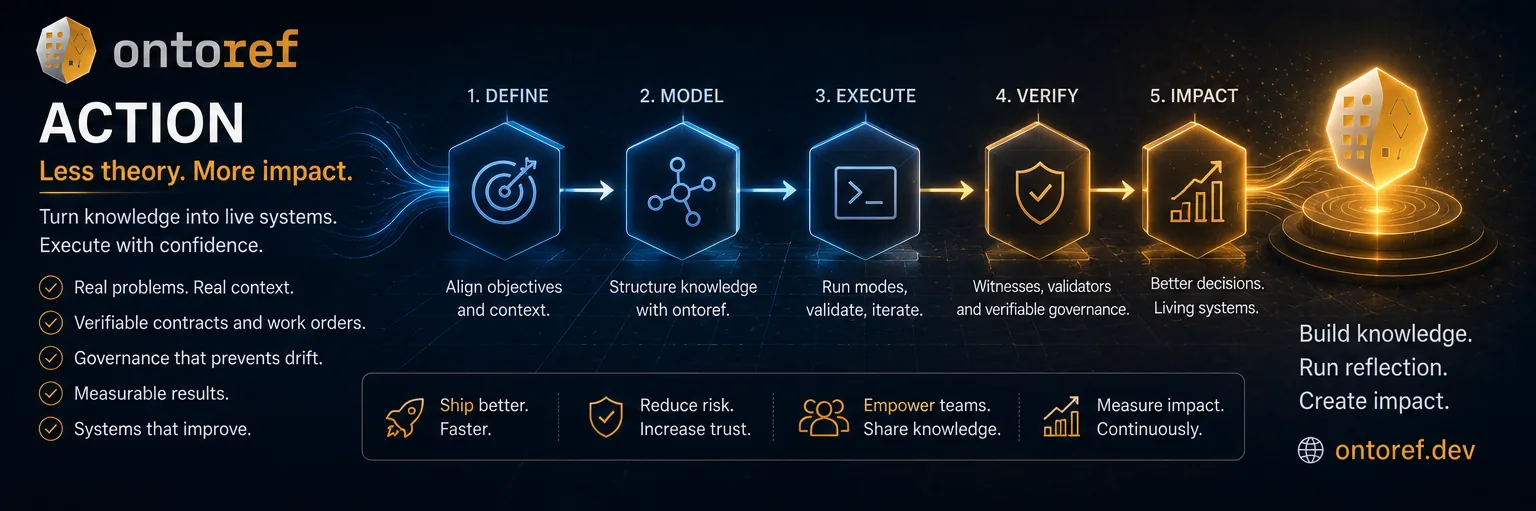
Where should you start?
Tell us your tier and your stack — we will point to the smallest first step, whether that is a coaching session or a tier-2 engagement.