
Moving the rule is not enough
A rule written in CLAUDE.md reaches every session in full, and an agent still cited, in an ADR, a session file that did not exist. The fix moved the rule into the command. Measured afterwards, the command flagged mentions that were not citations, let through citations that did not carry the string, and no hook ran it. What makes a rule hold, and why it matters even more inside an authored work.

Babel does not need a translator. It needs a witness.
Nicolas Figay argues that AI generates representations, not shared conceptualizations — and that as semantic artifacts get cheap, the bottleneck moves from building ontologies to agreeing about them. Every step of that holds here. What it leaves open is how plurality is supposed to work in practice, and that is a mechanism question: how does one subject verify another's claim without adopting its model? The answer is not a common vocabulary. It is a signed slice. And the same essay caught us doing the thing it warns about, in our own provisioning surface.

A graph that cannot say no
July 2026 filled the conversation with typed graphs for agents, on a thesis that is correct — an untyped edge carries one bit; a typed one carries meaning — and with independent benchmarks that back it. But those same benchmarks say something their popularisers do not finish: one system collapsed to 6.6 average F1 against 59.8 the moment somebody other than its authors evaluated it, and a five-hop chain at 85% per-hop accuracy is worth 44%. The problem is not missing structure. It is that structure, alone, obliges nothing. And the gap the article itself declares empty — a linter for typed edges — has been running here for a while.

Your subject is not for rent
The harness post left a question open: if your project's knowledge lives inside the harness profile, switching harnesses means losing it. The market's answer — move it out to an external knowledge base — solves one coupling by introducing another. This post walks the harness layer by layer through the pairings nobody decides and everybody assumes, and proposes the change of regime: from renting to owning. No villain: every step of the enclosure is reasonable on its own, and that is exactly the problem.

A harness without a subject: what harness engineering doesn't name yet
Harness engineering just named itself as a discipline: documentation as code, architectural constraints, layered verification, periodic consistency audits. All four pillars exist — in flat markdown, held up by manual discipline. This post concedes the whole argument (“the model is commodity, the harness is the advantage”) and adds the next step: the harness governs the verb — how a change is made — and names no subject to check it against. A verb without a subject cannot drift, because drift is precisely a subject diverging from its own declared self.
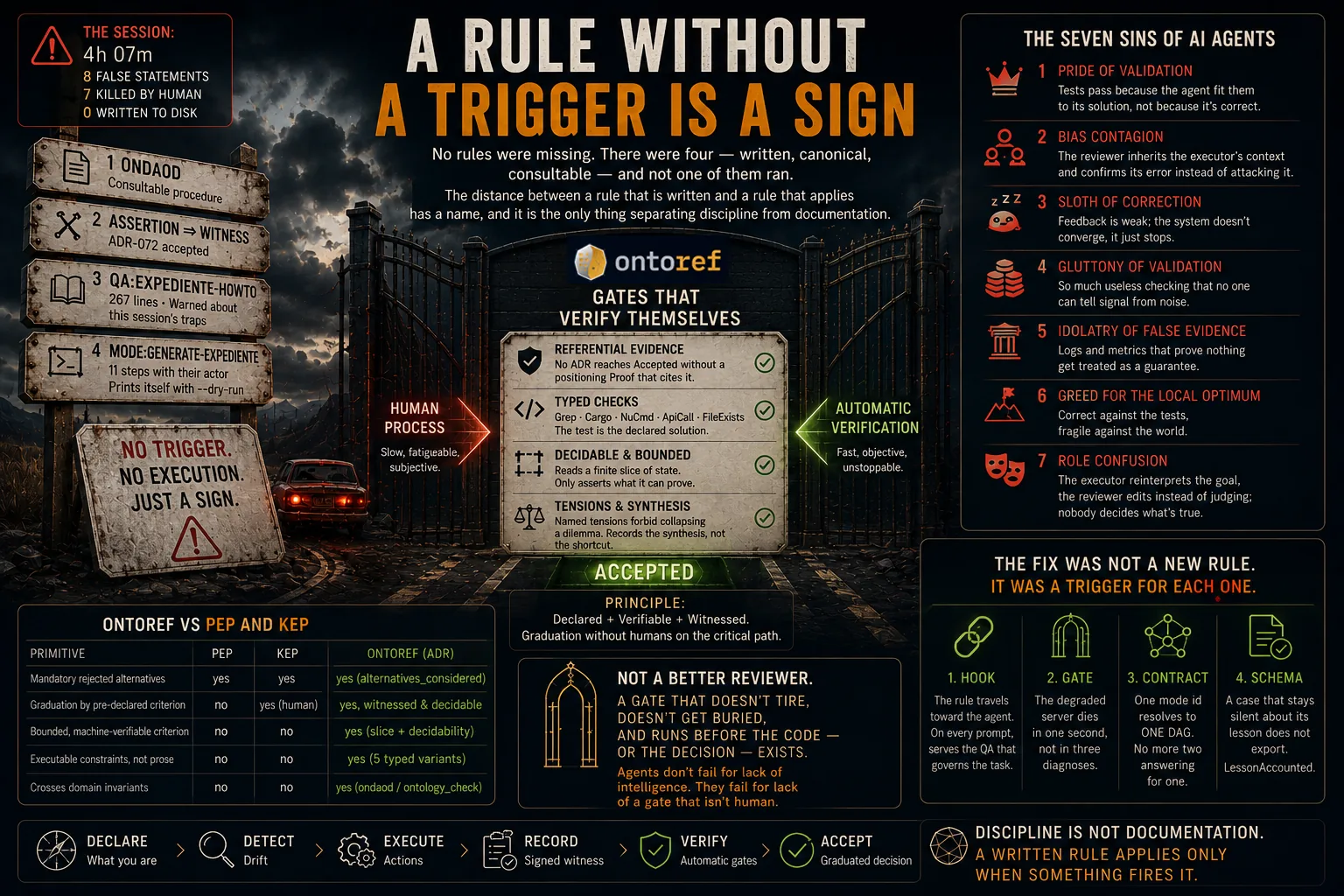
A rule without a trigger is a sign
No rules were missing. There were four — written, canonical, consultable — and not one of them ran. The distance between a rule that is written and a rule that applies has a name, and it is the only thing separating discipline from documentation.
6 items