
The mirror that does not flatter
It generalised from one example. It quoted a note instead of opening the file it pointed at. It called a check green when it had run nothing. It argued for three messages about a file it had not read. The someone was an AI agent, and the behaviours we file under «AI failure» turn out to be the oldest habits in any working life — only here they leave a trace anyone can re-run. Which leads somewhere less comfortable than a debate about machines: the standard you set for an agent is the standard you actually believe, said out loud, in a place where it gets enforced.
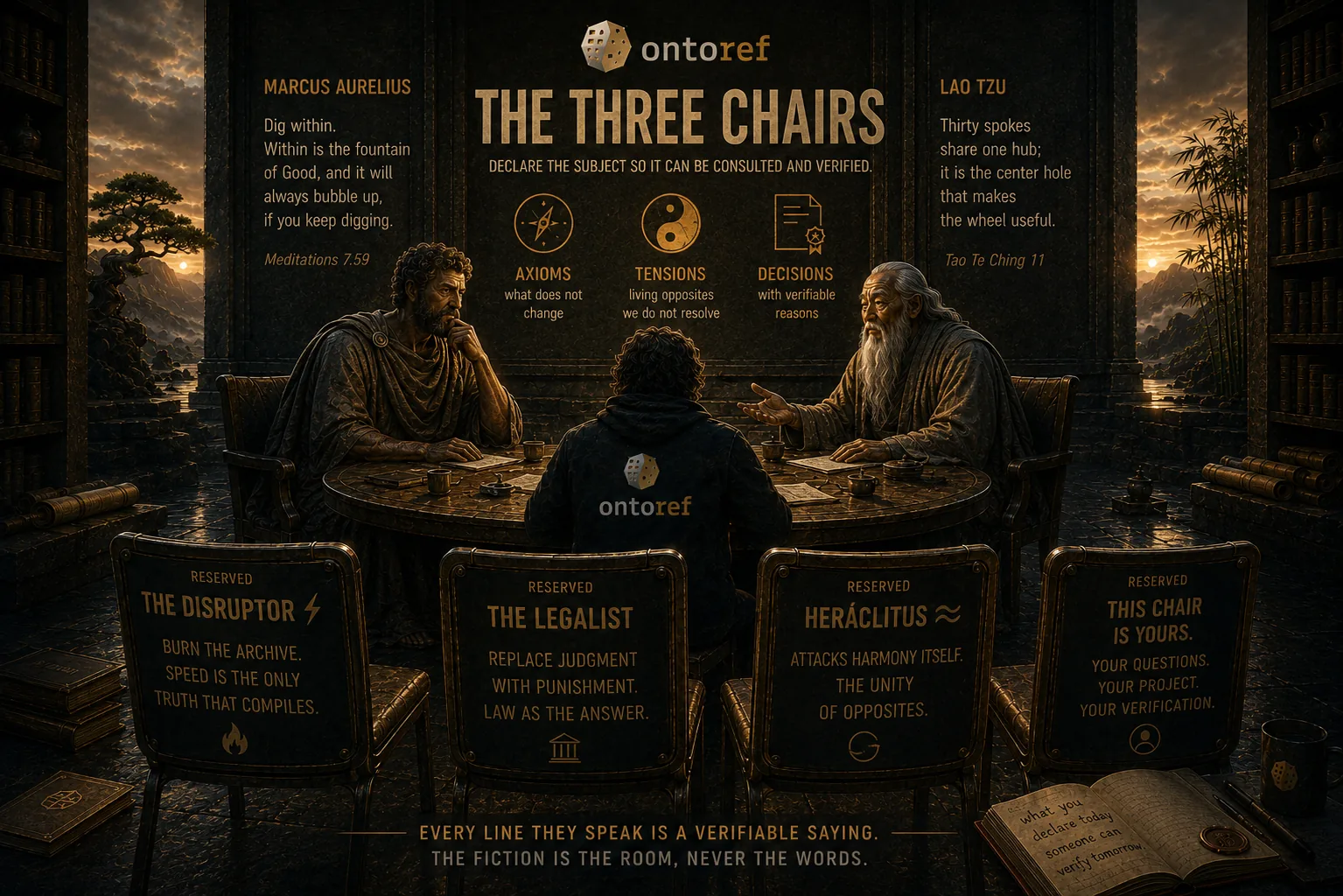
The three chairs
Why would a project pause to declare its axioms, keep its tensions deliberately unresolved, and make every decision carry signed reasons — now, in a time of machines that write faster than anyone can read? Instead of arguing it, this piece stages it: an unnamed maintainer asks, Marcus Aurelius and Lao Tzu answer only with their own attested words, and the skeptics are not straw men in the prose but guests in the room. The Disruptor demands speed, the Legalist demands law, and Heraclitus — the master of the unity of opposites — attacks the serenity of the evening itself. Two objections get answered by the guests. The third is answered by the structure of the interview. The session adjourns with no verdict, tensions open, and one empty chair reserved for the reader.

The Seven Sins of AI Agents
Agents don't fail at random: they fail with seven systematic vices that all survive the 'looks correct' test. The instinct is to add process — a PEP, a KEP, a committee — but every graduation stage rests on a human who approves it, and the agent's speed outruns the human you put at the gate. This is the honest comparison: what ontoref's ADRs inherit from PEP and KEP, and where they surpass both with witnessed, decidable, bounded-slice graduation criteria.

Trust Is an Output, Not an Input
An agent skipped the one invariant that would have caught the bug in thirty seconds. The honest diagnosis was not 'the agent forgot' — it was that the rule was prose, and prose never binds. This is the story of turning that failure into a falsifiable mechanism: a Statement of Work (the terms you own) and a Work Order (the execution it can't edit), where 'done' carries the validator's output instead of the agent's word.
4 items