The three chairs
A maintainer with no name interviews Marcus Aurelius and Lao Tzu about why a project would declare what it is. In the audience, three reserved chairs: a Futurist who wants to burn the archive, a Legalist who wants to replace judgment with punishment, and Heraclitus — who came to attack the harmony itself. Every line the guests speak is a verifiable saying. The fiction is the room, never the words.
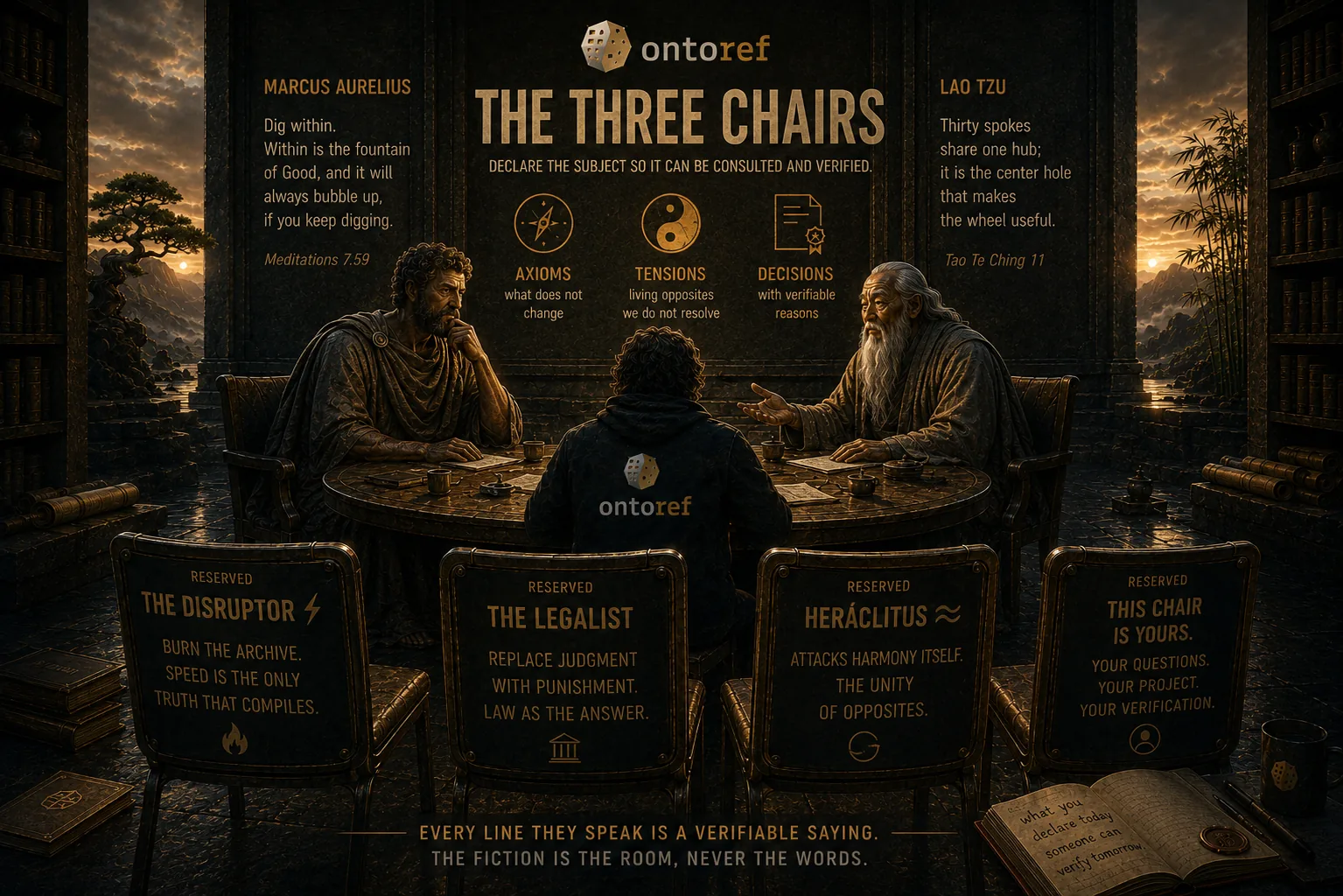
The room is small and nobody important is in it. A table, two guests who have been dead for a very long time, and a person with no name who maintains a project and has agreed to ask the questions. Three chairs stand in the audience, reserved. They will not stay quiet — that is why they were invited.
The maintainer does not intend to sell anything tonight. The guests would not allow it anyway. The question on the table is narrower and harder: why is this thing built the way it is, and what sense does that shape make now — in a time of machines that write faster than anyone can read.
I. The shape
Maintainer: I keep a project. Before I let anyone — human or machine — work on it, I make the project declare what it is: its axioms, its unresolved tensions, its decisions with the reasons attached. People tell me this is overhead. Marcus, you ran an empire from a war camp. Why would anyone pause to write down what they already know?
Marcus Aurelius: Because you do not already know it. Dig within. Within is the wellspring of Good; and it is always ready to bubble up, if you just dig. The digging is the point. A man who has never written down what he holds true discovers, under pressure, that he holds nothing in particular. So does a project. If it is not right, do not do it; if it is not true, do not say it — but to obey that sentence you must first be able to say what the project holds as right and true. The declaration is not overhead. It is the part of the project that can refuse.
Maintainer: Lao Tzu, the same file that declares the axioms declares tensions — pairs of opposites the project promises never to resolve. Formalize, or stay adoptable. Enforce, or let practice emerge. My critics say an unresolved question is an unfinished design.
Lao Tzu: Thirty spokes share one hub. It is the hole in the center that makes the wheel useful. You have built holes on purpose and your critics are counting spokes. A question resolved is a wheel filled in: solid, heavy, and it does not turn. The tension you refuse to collapse is the emptiness the project turns on.
Maintainer: And when I do decide — a real decision, with alternatives rejected — I make the decision carry its own reasons, signed, so that undoing it later costs a deliberate act and not a Tuesday.
Marcus Aurelius: Waste no more time arguing what a good man should be. Be one. A decision that cannot say why it was taken is an argument, not an act. Write the why into the act itself and you are free to stop arguing.
II. Now — the fast ones
Maintainer: Here is why this stopped being philosophy for me. I now work with machines. They are brilliant and they are amnesiac — each session they arrive knowing nothing of what we decided, and they write faster than I can review. Everyone’s answer is to make them faster still.
Marcus Aurelius: Speed was never the emperor’s problem; the couriers were fast enough. The problem was arriving at each morning without a self to consult. The mind takes the shape of what it frequently holds. Your machine holds nothing between mornings — so you must hold it for the machine, outside it, where you can read what is held. Do not ask the scholar to be smarter. Give the scholar somewhere to keep what it learned.
Lao Tzu: Govern a great state as you would cook a small fish. Too much stirring and it falls apart. Your fast machines are a great state now — do not stir them with your hands all day. Set the pan, the fire, the moment to act and the moment to leave alone; that is what your declarations are. When the work is done, the people say: we did it ourselves. If your machine finishes and believes it worked unguided, and yet everything it did lands inside what the project holds true — that is government.
Maintainer: So the ontology is the pan and the fire.
Lao Tzu: And the gate is knowing when not to open the lid.
Maintainer: It is not one kind of project, either. The same shape now holds an infrastructure that provisions machines, a web framework and the sites built on it, the writing of books — a person’s Work — and one person’s own life, kept as a subject with axioms of its own. Different domains, one discipline: declare the subject, keep the tensions alive, make every decision carry its reasons.
Marcus Aurelius: What injures the hive injures the bee. If the shape is true it will not care whether the hive stores honey or books or machines. That it holds across your domains is not a feature. It is the evidence.
III. The chairs
The first chair has been vibrating for some time. The man in it stands without being called: scarf, driving gloves, the smell of gasoline. The Disruptor.
The Disruptor: I have heard enough embroidery. We want to demolish museums and libraries! A roaring motorcar is more beautiful than your Victory of Samothrace — and my agents ship while your project is still declaring what it is. Who has time for ontologies? Burn the archive. Speed is the only truth that compiles.
Maintainer: I won’t answer that. Guests?
Lao Tzu: A tree you can barely embrace grew from a shoot; a journey of a thousand miles begins beneath your feet. You are not against roots because they are slow. You are against them because they are yours to grow and cannot be stolen from a museum. Burn every archive you like — your motorcar still runs on roads someone maintained.
Marcus Aurelius: The impediment to action advances action. What stands in the way becomes the way. You experience the declaration as an obstacle to speed. It is the road. Your agents do not lack velocity; they lack somewhere for velocity to accumulate. Yesterday’s sprint taught yours nothing — you merely paid for it again today at full price.
The second chair does not stand. He speaks seated, hands folded, and the room gets quieter. The Legalist.
Han Feizi: The masters flatter you. The sage does not rely on people becoming good; he makes it impossible for them to do wrong. And the law does not fawn on the noble, as the plumb line does not bend for crooked wood. Your «living tensions» are sentiment. Fix the rules. Make every deviation a punishment. If your machine can err, your system — not your philosophy — is at fault.
Maintainer: Half of him I cannot refuse. Some of my constraints are hard: they fail the build, no appeal, plumb-line straight.
Lao Tzu: Keep those. But hear the other half: the more laws and edicts are promulgated, the more thieves and bandits there will be. Write a rule for everything and you will breed specialists in the gaps between rules. Your machines are already the fastest gap-finders ever built.
Marcus Aurelius: And a rule obeyed without understanding trains obedience, not judgment. I would rather my successor understand one reason than fear ten punishments — fear ends with the enforcer. So: the plumb line for what must never bend, and for everything else, a recorded direction of motion. Both of you, in tension. Held, not resolved.
Han Feizi: (a pause) You have made my law one pole of your system.
Maintainer: Yes. And your chair is still in the room.
The third chair. The man in it has been smiling darkly since the beginning. He does not stand either; he barely raises his voice. Heraclitus.
Heraclitus: I did not come to attack the project. I came to attack this evening. Your serenity bores me and it should frighten you. War is father of all and king of all. An interview where everyone converges is embroidery over a corpse. Where is the conflict, maintainer? A thing without strife is a thing already dead.
Maintainer: (turning over a page, reading) Formalization against adoption. Enforcement against emergence. Openness against sustainability. Named, versioned, and forbidden — by written discipline — from ever being resolved. The file instructs anyone who reasons about this project to describe which way each war is moving, and prohibits declaring a winner.
Heraclitus: (silent for a moment) …They do not comprehend how, in differing, it agrees with itself: a back-turned harmony, as of the bow and the lyre.
Maintainer: That sentence is in the design. Not quoted — obeyed. Your strife is the load-bearing member. You have been inside the system since before you sat down.
Heraclitus: The hidden harmony is better than the obvious one. …I have no question, then. I have a complaint: you have made my war survivable. I am not certain I forgive that.
Adjournment
Maintainer: No verdict tonight. Marcus — one line to close?
Marcus Aurelius: Confine yourself to the present. The project you declared today will be wrong tomorrow. Declare it again. That is not failure; that is the practice.
Lao Tzu: The Tao that can be spoken is not the eternal Tao. Your files are not the project either — they are the finger, and the moon does not resent the finger. Keep pointing. And leave the hub empty.
The maintainer gathers the papers. The Disruptor is already gone — there was a noise of engines. Han Feizi remains seated, copying something into a notebook. Heraclitus stays until the lamps are out, looking at the fourth chair, the empty one, the one that was reserved for whoever is reading this.
Session adjourned. Tensions open.
Appendix — the seating chart
| Chair | Voice | What it collapses | The tension it embodies |
|---|---|---|---|
| First | the Disruptor (Marinetti, 1909) | burn the declared past, ship | formalization vs adoption, collapsed to adoption |
| Second | the Legalist (Han Feizi) | replace judgment with punishable rules | enforcement vs emergence, collapsed to enforcement |
| Third | Heraclitus (DK B51, B53, B54) | denounces harmony — and describes the Spiral | the tension mechanism itself |
| Fourth | empty | — | reserved for the reader |
Every guest line is a verifiable saying: Marcus Aurelius, Meditations 5.20, 6.54, 7.59, 8.44, 10.16, 12.17; Lao Tzu, Tao Te Ching 1, 11, 17, 57, 60, 64, 78; Heraclitus, Diels-Kranz B51, B53, B54; Han Feizi, You Du and Xian Xue; Marinetti, Futurist Manifesto (1909). The fiction is the room, never the words.