Your Ontology Should Live With Your Code
Sovereignty, federation, and why knowledge infrastructure without a home isn't infrastructure at all
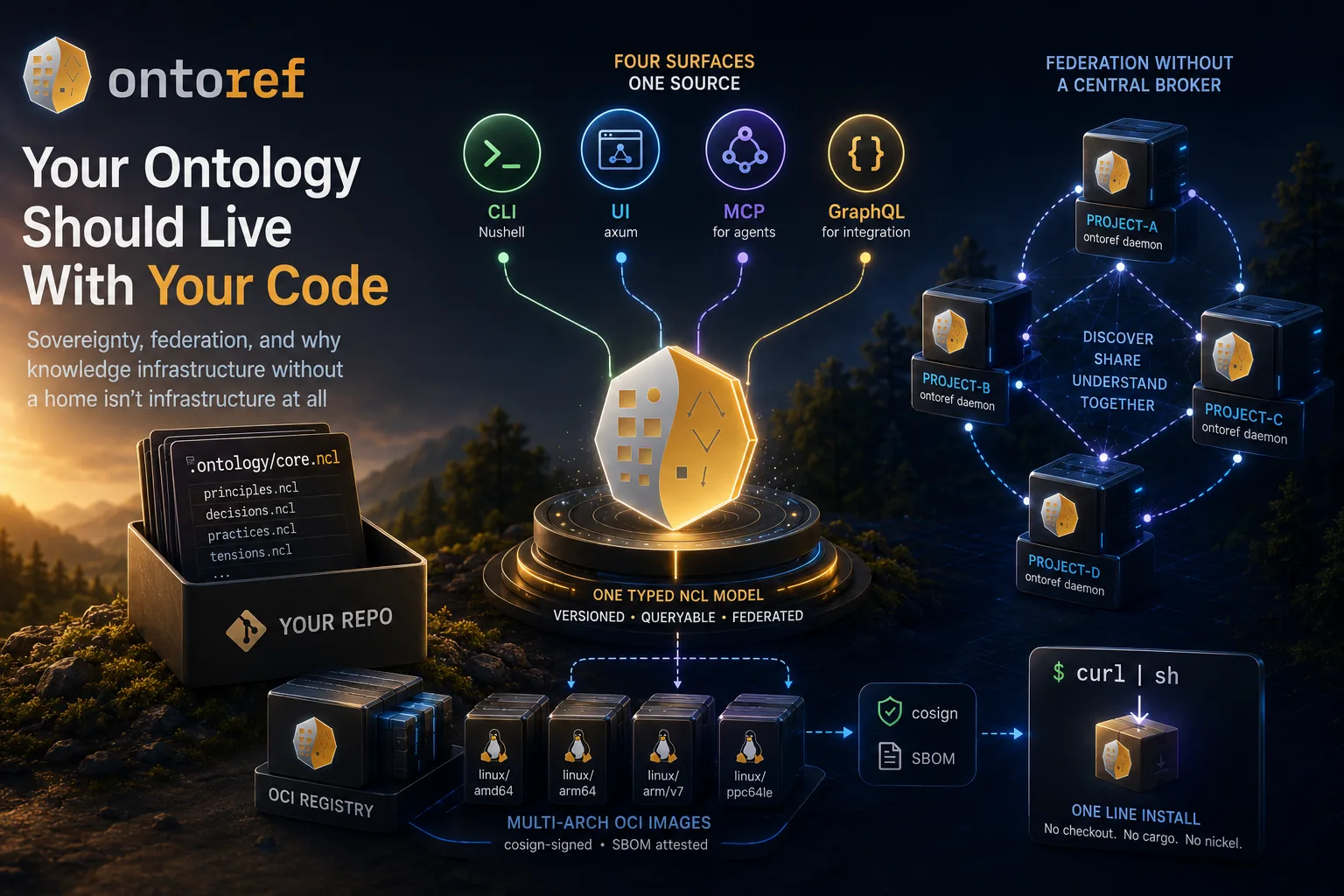
Your Ontology Should Live With Your Code
Jessica Talisman, in her KGC 2026 talk, says something worth highlighting: “Your ontology is your moat — your IP.”
She’s right. And she’s describing the enterprise knowledge graph model, where the moat is held in a vendor’s triplestore, maintained by a dedicated team, on a platform with a subscription. When the team changes, the budget gets cut, or the vendor pivots, the moat drains.
Ontoref takes the opposite approach.
What Sovereign Knowledge Means
In ontoref, the knowledge of what a project is — its principles, practices, tensions, architectural decisions, operational state — lives as NCL files alongside the code. In the repository. Versioned with the same discipline as the source.
This is not a documentation approach. It’s a storage decision with architectural consequences:
- No vendor can take it from you. The ontology is in your repo, not their database.
- No platform migration. GitHub, Gitea, Radicle — the knowledge moves with the code.
- No dedicated infrastructure. The daemon runs locally; the files are the source of truth.
- Offline by default. Knowledge that requires a network connection to exist is not infrastructure — it’s a service.
The closest analogy is SQLite vs. PostgreSQL: local-first, embedded, always available, no connection required. When you need distribution, you add it. But the baseline is sovereignty.
Four Surfaces, One Source
Sovereign storage doesn’t mean isolated. Ontoref exposes the same ontological knowledge across four surfaces simultaneously:
CLI (Nushell): The developer’s native interface. ontoref describe project, ontoref graph ontology, ontoref sync diff --docs. Fast, scriptable, CI-composable. The surface for humans who live in the terminal and for automated checks that run in pipelines.
UI (axum): A web interface for visual inspection, onboarding, and management. Not a dashboard over a remote API — a local server that renders the same NCL-backed knowledge. The surface for project managers, new contributors, or anyone who prefers navigating a graph visually.
MCP: The agent surface. Ontoref’s MCP endpoint is the semantic layer that sits above the transport protocol. As Talisman’s framework correctly identifies, MCP moves bytes — it doesn’t establish shared meaning. Ontoref provides that meaning through its ontological layer, exposed via MCP to agents that need structured knowledge about the project to work accurately rather than hallucinate context.
GraphQL: The integration surface. SPARQL is the semantic web standard, but GraphQL is what most developers know and every tooling ecosystem supports. A GraphQL API over the ontological DAG removes the barrier of expertise without sacrificing structure.
Four surfaces, one canonical source: the NCL files in the repository.
jj and Radicle
The storage model pairs naturally with a specific class of VCS tooling.
Jujutsu (jj): A Git-compatible VCS where the working copy is always a commit — there is no dirty state. This aligns directly with ontoref’s approach to continuous state capture: every project state is capturable, every transition is a first-class event. jj’s operation log is the VCS equivalent of ontoref’s reflection session history.
Radicle: P2P, local-first, sovereign code collaboration. If the code is sovereign, the knowledge about that code should be too. Radicle as transport means the federation of ontoref-enabled projects doesn’t depend on any centralized platform — no GitHub, no GitLab, no hosted Gitea. Nodes discover each other and exchange knowledge directly.
Together: sovereign code and sovereign knowledge, distributed without a central broker.
Federation Without a Central Broker
The enterprise model for knowledge federation is a central knowledge graph that all projects point to. One team maintains it. One platform hosts it. Every query routes through it.
Ontoref’s federation model is different:
project-A queries: which projects implement "zero-trust-auth"?
project-B, project-C respond from their own ontologies
no central server that knows everything
This is possible because each project is self-describing. The ontological DAG in .ontology/core.ncl is queryable without any external dependency. Federation via NATS connects the daemons — each project’s daemon registers itself, publishes its capabilities, and responds to queries from other daemons in the federation.
The result: ecosystem-level visibility without ecosystem-level centralization. You can discover which projects share your architectural constraints, which implement compatible practices, which are in conflicting states — without any of them requiring a shared platform.
Why This Architecture Now
Two shifts made this viable:
Agentic AI as the consumer. Before agents, knowledge infrastructure was built for human consumption — ontologists maintaining graphs for analysts to query. Agents are different: they need machine-readable, structured, typed knowledge to operate accurately. Ontoref’s multi-surface model is designed for a world where the primary consumer of project knowledge is not a human reading a wiki but an agent making decisions in a context window.
Local-first as the default. The decade-long trend toward cloud-hosted everything is reversing for knowledge infrastructure. The risks are clear: vendor lock-in, platform discontinuity, sovereignty loss, and the compounding cost of external dependencies for what should be internal knowledge. Local-first with optional federation is the architecture that survives platform changes.
The Moat Argument
Talisman’s framing — “your ontology is your moat” — is more accurate than she might intend it to be. A moat works because it’s attached to the thing it protects. A moat stored in someone else’s database is not a moat. It’s a service agreement.
When the knowledge of what your project is, why it exists as it does, and what decisions have lasting consequences lives alongside the code that implements those decisions — versioned, queryable, sovereign, federated — it is genuinely yours. It accumulates. It survives team changes. It informs agents. It can be queried by projects that depend on you.
That’s the kind of moat worth building.
Ontoref is open source. The protocol specification, Nushell automation, and Rust crates are at repo.jesusperez.pro/ontoref/ontoref.