
Babel does not need a translator. It needs a witness.
Nicolas Figay argues that AI generates representations, not shared conceptualizations — and that as semantic artifacts get cheap, the bottleneck moves from building ontologies to agreeing about them. Every step of that holds here. What it leaves open is how plurality is supposed to work in practice, and that is a mechanism question: how does one subject verify another's claim without adopting its model? The answer is not a common vocabulary. It is a signed slice. And the same essay caught us doing the thing it warns about, in our own provisioning surface.

A graph that cannot say no
July 2026 filled the conversation with typed graphs for agents, on a thesis that is correct — an untyped edge carries one bit; a typed one carries meaning — and with independent benchmarks that back it. But those same benchmarks say something their popularisers do not finish: one system collapsed to 6.6 average F1 against 59.8 the moment somebody other than its authors evaluated it, and a five-hop chain at 85% per-hop accuracy is worth 44%. The problem is not missing structure. It is that structure, alone, obliges nothing. And the gap the article itself declares empty — a linter for typed edges — has been running here for a while.
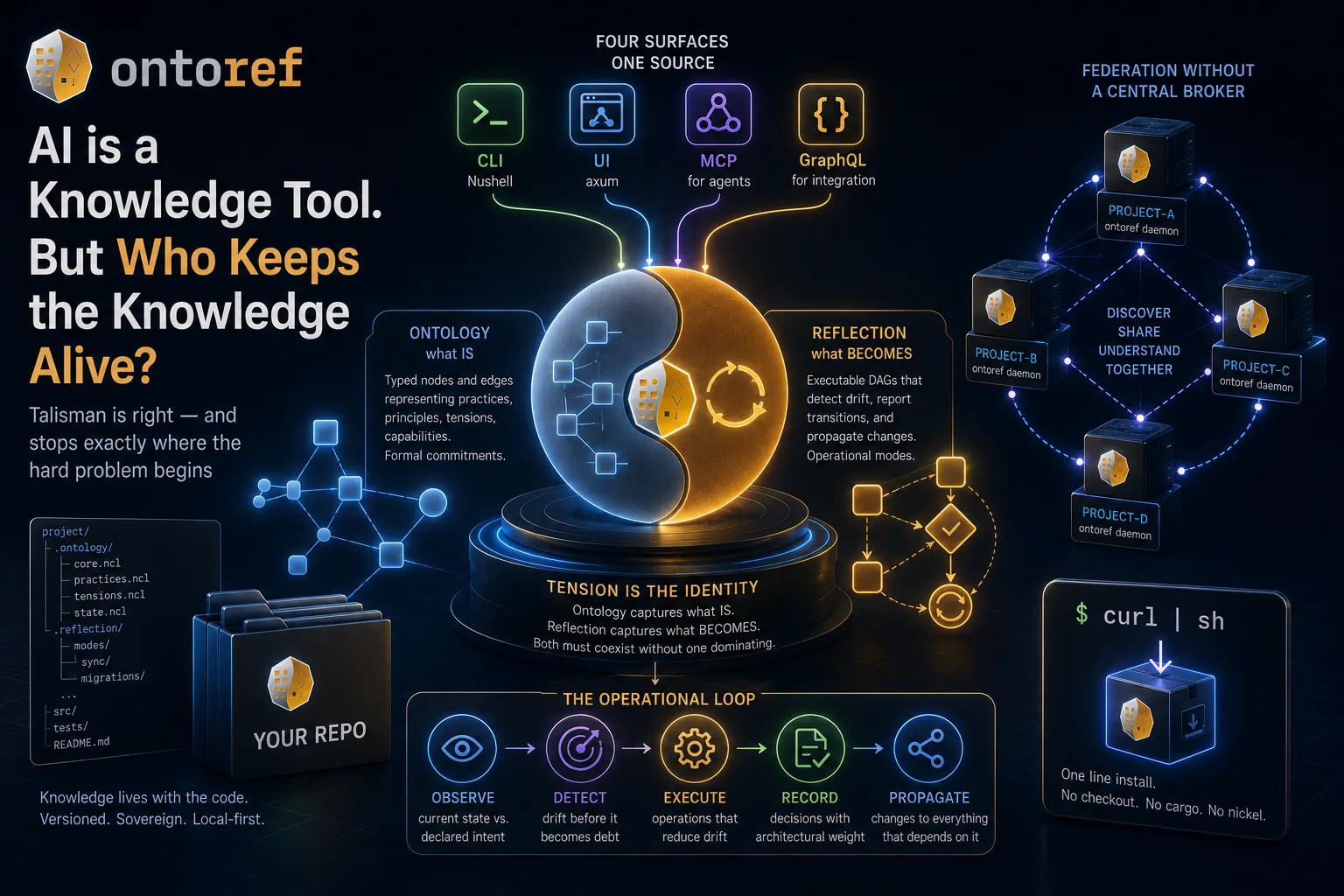
AI is a Knowledge Tool. But Who Keeps the Knowledge Alive?
Jessica Talisman's KGC 2026 talk is the clearest articulation of why AI strategies fail: organizations invest in data infrastructure and expect reasoning to emerge. She's right. But her solution — build knowledge infrastructure — stops exactly where the hard problem begins: who keeps the knowledge from drifting?
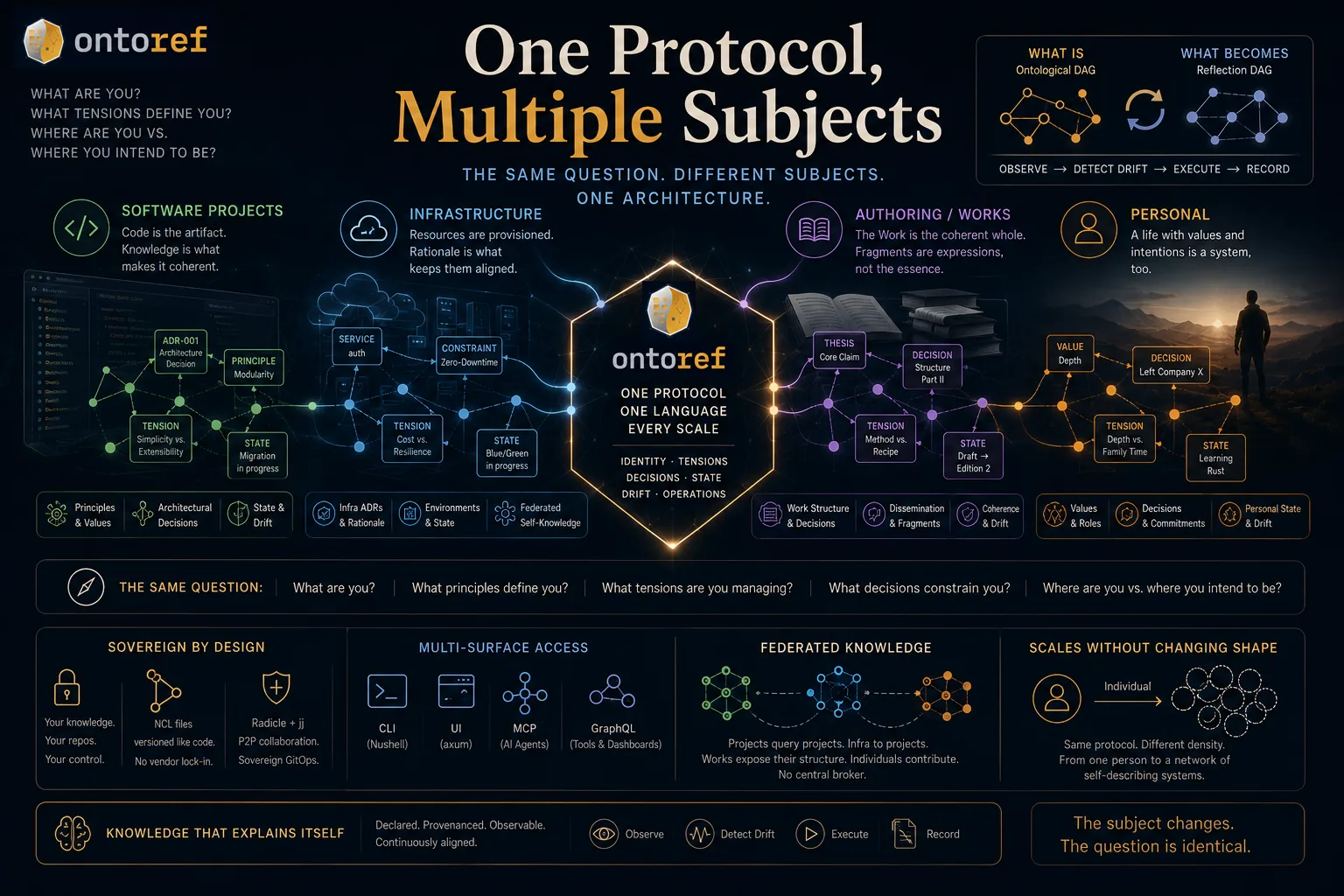
One Protocol, Multiple Subjects
Ontoref started as a protocol for software project self-knowledge. The same architecture — an ontological DAG for what IS, a reflection DAG for what BECOMES — applies without modification to infrastructure environments, to a body of authored work, and to individuals. The subject changes. The question is identical: what are you, what tensions define you, where are you versus where you intend to be?
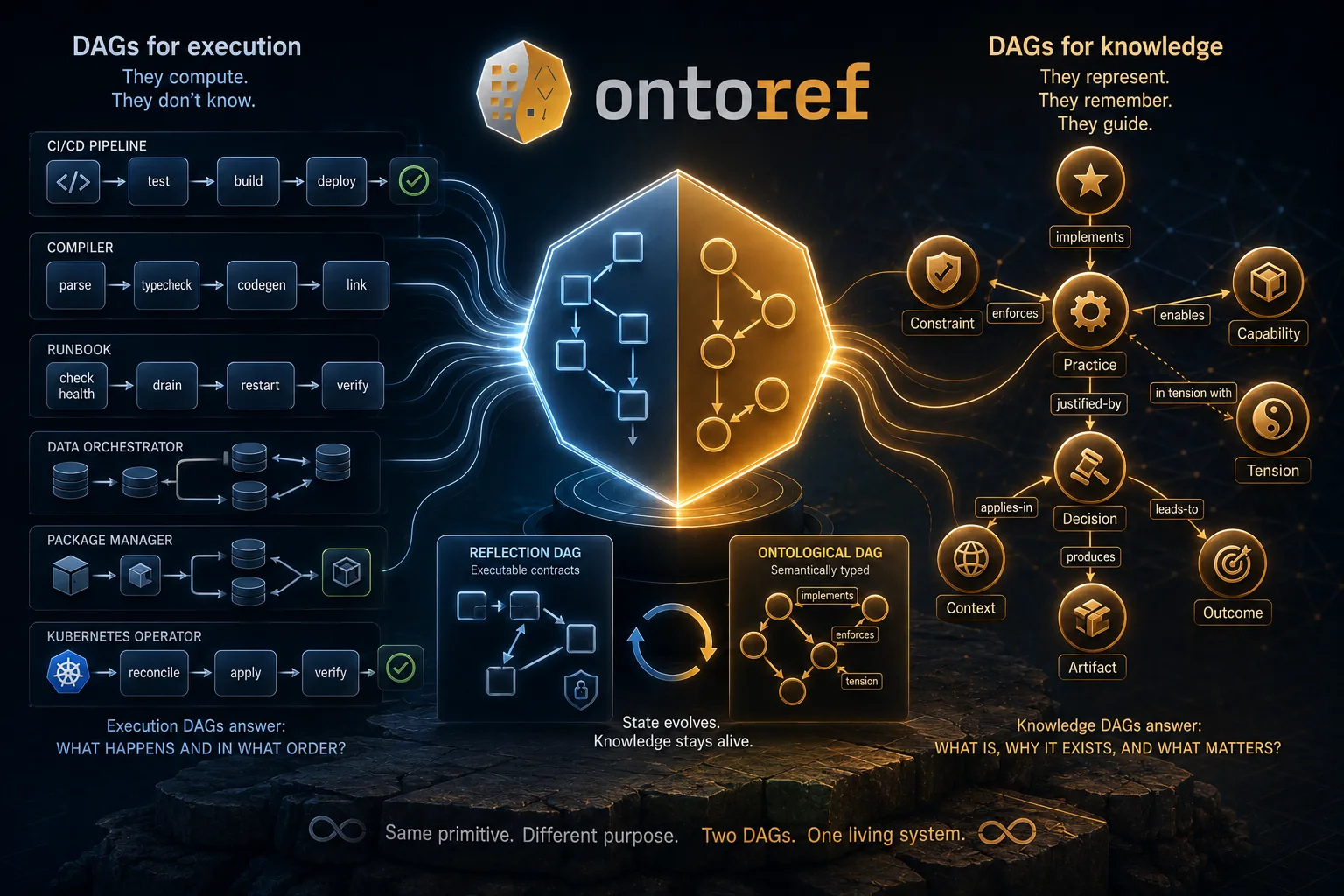
DAGs Are Everywhere. None of Them Know What They Are.
CI/CD pipelines, compilers, runbooks, data orchestrators — they all use directed acyclic graphs. Every single one of them uses DAGs as execution models: this before that, topological ordering, dependency resolution. None of them use DAGs to represent what the system is, why it exists, or what trade-offs define it. That's the gap ontoref fills.
5 items